
Tuesday, November 15, 2016
Creating a Pastel...
These videos demonstrate using pastels to create a still-life object. It's helpful to see how other artists use a medium. Everyone has different ways to approach drawing.
Wednesday, November 9, 2016
Adding watercolor pencil to your drawing....
Now that you have completed a contour drawing of the still-life it is time to add COLOR!! When you think about color remember it might take mixing some colors to arrived at the right one. Begin by choosing the color you see the most of and then look for any other colors that are there, a pumpkin isn't always orange-it could have some yellows, reds, browns, greens, even blues in it.




Creating and Interesting Composition...
6th Grade Still-Life Composition
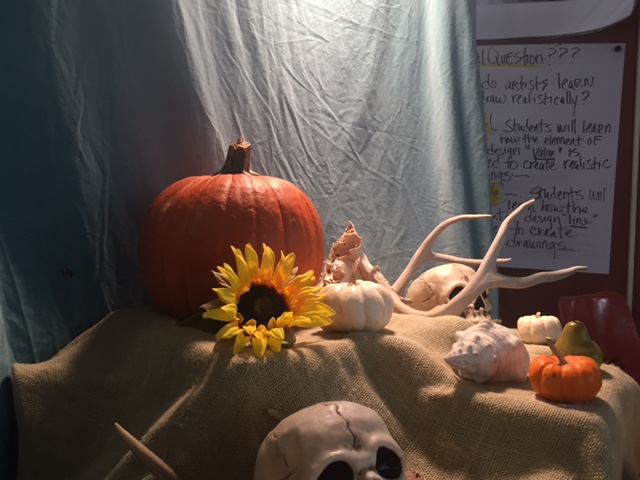
A still-life is a grouping of inanimate (not moving or living) objects, arranged as a subject or reference for a work of art. Now that you have finished your value drawings it is time to explore color and how you can represent VALUE using color! You will be creating a pastel drawing of "seasonal" objects. One of our goals is to create an interesting composition by cropping. This will create interest and emphasis on a particular area. You can make your selection using a viewfinder and/or a camera. Below is an example of cropping. Decide your composition, photograph it, print it, do a thumbnail sketch, then start a very light contour drawing on a piece of pastel paper.


A still-life is a grouping of inanimate (not moving or living) objects, arranged as a subject or reference for a work of art. Now that you have finished your value drawings it is time to explore color and how you can represent VALUE using color! You will be creating a pastel drawing of "seasonal" objects. One of our goals is to create an interesting composition by cropping. This will create interest and emphasis on a particular area. You can make your selection using a viewfinder and/or a camera. Below is an example of cropping. Decide your composition, photograph it, print it, do a thumbnail sketch, then start a very light contour drawing on a piece of pastel paper.


Working with Pastels
When I use pastels the most challenging thing for me is to keep it neat. I tend to rest my hand on the paper (not a good idea) or I accidentally put something on the paper and it creates a smudge or mark. The good thing about pastels if applied in light layers you can create depth and richness without damaging the tooth (surface texture) of the paper. You can also deal with most "mistakes" if you begin with planning your composition carefully by working it all out with thumbnail sketches. There are many ways to create a pastel painting. I will demonstrate a few in class but I would also like you to view the blog below. It shows examples and descriptions of the process the artist went through while creating her pastel painting.
Here is a link to view the entire blog:
 |
| Under drawing (blueprint) |
 |
| Foundation (blocking in color) |
 |
Construction, building and layering color |
Here are a couple other informative links:
Thursday, October 20, 2016
Happening in art class....
5th & 6th graders, and Unified Arts classes have been busy being amazing artists!
Take a look at what's going on...


Take a look at what's going on...


Tuesday, October 11, 2016
"In-Between" Seasonal Artsy Lesson
I cannot resist doing something with leaves for a mini-break from our drawing lessons...


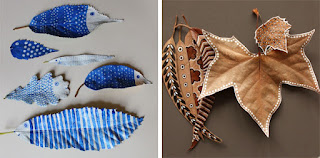


Take a look at the examples of different ways to decorate leaves.


Embellish a leave with the element of design SHAPE or LINE. When we repeat a shape or line it creates PATTERN and MOVEMENT. Many cultures and artists use REPETITION of shapes, line, and color to create beautiful works of art.


Take one leaf from my collection and create a pattern using line, shape, and color! If you would like to do more bring some leaves in from home. All you have to do is go outside and find some leaves that aren't too dry, maybe they are still on the tree and then place them in a book to flatten them.
Bring them in to the next art class to make into stunning works of art!


Take one leaf from my collection and create a pattern using line, shape, and color! If you would like to do more bring some leaves in from home. All you have to do is go outside and find some leaves that aren't too dry, maybe they are still on the tree and then place them in a book to flatten them.
Bring them in to the next art class to make into stunning works of art!
Tuesday, October 4, 2016
Embrace the Shake...overcoming unexpected obstacles
Creativity and Exploration come hand in hand. Phil Hansen really knows how to embrace obstacles as a learning experience. Take a look.
HOW can YOU create a CONTOUR drawing??

CONTOUR lines not only shows us the shape of the subject/object they show us the edges. You can see the depth of the object by the way the contour lines are drawn. A contour drawing does not show us where the light source is, leaving some things about the subject/object a mystery.

Mona Brookes, author of Drawing for Older Children and Teens, writes:
"By following what appears to be the outline edges of an object, you can create an impression of it. Contour Drawing is a style of realistic drawing, but it doesn't capture the kind of three-dimensionality that you can achieve with shading."
Below notice the way Pablo Picasso uses a line to represent most of the edges of the figure below. He tried to keep the correct proportions and successfully portrays the physical characteristics of the model. Learning how to create contour drawings is a fundamental skill that all artists should develop.
 |
| Contour Drawing |
 |
| Outline |
Monday, September 26, 2016
Finding VALUE in PUMPKINS
Of course pumpkins have value, they have a beautiful color, without them what would fall and Halloween be??? So pumpkins are valuable, but where can we see the Element of Design VALUE in them? When you have completed all of your warm-up VALUE exercises, do a pencil sketch of a pumpkin from my desk. Make sure you show all the highlights, mid-tones, and shadows (core and cast) that you see. Take a look below at a great example of this exercise:


Remember all that you learned when doing the value exercises, ask yourself these questions:
- Where is the darkest value?
- Where is the lightest value?
- How dark is the pumpkin compared to the stem and the paper?
- Is the stem thin, thick, curvy, short?
Take your time observing...
After you finish the drawing and you have done your best, complete the following reflectio/assessment: Pumpkin Value Rubric
Subscribe to:
Posts (Atom)