Monday, December 5, 2016

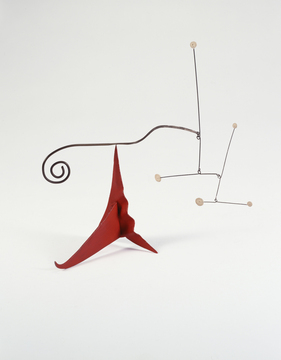
Alexander Calder


"Calder's Lobster Trap and Fish Tail is a hugely important piece of Art History because it changed the way people saw sculpture. Before Calder all sculpture was static, something to symbolize rigidity, and by adding a graceful motion to his sculptures Calder redefined the genre forever. Sculptures could now have grace, and they could change into a completely different form. His radical designs were unlike anything made before and furthered the abstract movement. With moving sculptures, onlookers could see different meanings and interpretations each time they looked at them. He truly revolutionized sculpture in modern art."  

Shepard Fairey- Art with a Message

Sunday, December 4, 2016

Creating Art with Wire

Now that we have completed our STUNNING pastel still-life drawings we are going to explore creating art using wire.  Take a look at some wire sculptures below.   Even though they all have wire as part of the sculpture they use the material in a variety of ways.  Which ones are you most interested in and why?


Tuesday, November 15, 2016

Creating a Pastel...

These videos demonstrate using pastels to create a still-life object.  It's helpful to see how other artists use a medium.   Everyone has different ways to approach drawing.


Wednesday, November 9, 2016

Adding watercolor pencil to your drawing....

Now that you have completed a contour drawing of the still-life it is time to add COLOR!!  When you think about color remember it might take mixing some colors to arrived at the right one.   Begin by choosing the color you see the most of and then look for any other colors that are there, a pumpkin isn't always orange-it could have some yellows, reds, browns, greens, even blues in it.  


Creating and Interesting Composition...

6th Grade Still-Life Composition


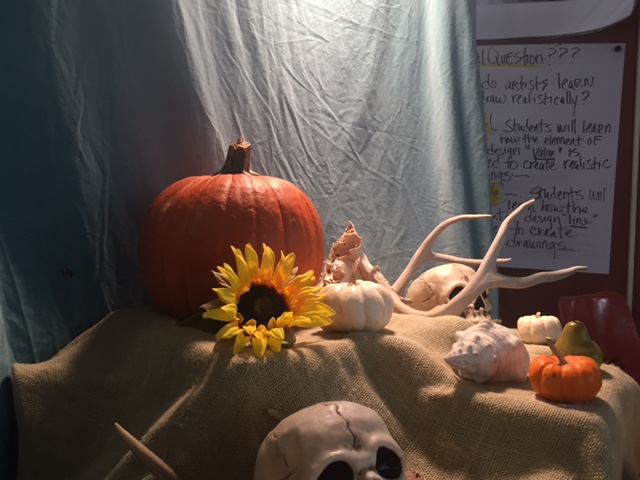
A still-life is a grouping of inanimate (not moving or living) objects, arranged as a subject or reference for a work of art. Now that you have finished your value  drawings it is time to explore color and how you can represent VALUE using color!  You will be creating a pastel drawing of "seasonal" objects.  One of our goals is to create an interesting composition by cropping.  This will create interest and emphasis on a particular area.  You can make your selection using a viewfinder and/or a camera.   Below is an example of cropping.  Decide your composition, photograph it, print it, do a thumbnail sketch, then start a very light contour drawing on a piece of pastel paper.  


Working with Pastels

When I use pastels the most challenging thing for me is to keep it neat.  I tend to rest my hand on the paper (not a good idea) or I accidentally put something on the paper and it creates a smudge or mark.  The good thing about pastels if applied in light layers you can create depth and richness without damaging the tooth (surface texture) of the paper.  You can also deal with most "mistakes"  if you begin with planning your composition carefully by working it all out with thumbnail sketches.  There are many ways to create a pastel painting.  I will demonstrate a few in class but I would also like you to view the blog below. It shows examples and descriptions of the process the artist went through while creating her pastel painting. 
 
Here is a link to view the entire blog: 

Under drawing (blueprint)

Foundation (blocking in color)

Construction, building and layering color


Finishing Touches


Here are a couple other informative links:


Thursday, October 20, 2016

Happening in art class....

5th & 6th graders, and Unified Arts classes have been busy being amazing artists!  
Take a look at what's going on...