Thursday, March 19, 2015

Advanced Drawing and Painting


"Each of these luminous and mysterious images of trees against sky, field, and river evoke a subtle variation of light and atmosphere. The arrangement of the trees - whether standing in solitude or in pairs or in large groupings seem at once inevitable and yet surprising, formal yet accidental. All of these paintings are comprised from memory, imagination and thumbnail sketches from my beautiful basement studio in my home in Connecticut. I work on wood board, paper and canvas using several layers of gesso before priming the surface with cadmium red base, a quick sketch using charcoal is used to lay out the design then the paint is applied. I work in layers using thinned down oil color, building on these layers with glazing techniques the colors are adjusted and brought up to completion before final coats of varnish are applied. Light has come to play an important part, and when I look back over this body of work, I feel it speaks about spiritual places, places that contain a quiet inner light, radiating an ethereal whisper, the places we see every day."
- William McCarthy


Your next assignment is to create an acrylic landscape that experiments with the layering of color to create a luminous atmosphere.   William McCarthy takes photographs and draws thumbnail sketches of landscapes that have an appealing composition or beautiful lighting.  He then goes back to the studio and creates a landscape that may or may not be representational.  Some artists would prefer only to paint outside looking at the natural world and how the sun affects it, there are many ways to create a landscape or seascape. You can be inspired by a sunset, but not want to duplicate it.  There is no right or wrong way to approach drawing a natural setting it would be ideal to pause the perfect sunset so you can paint what you are seeing, but you can't.  
View Assignment HERE


Friday, March 13, 2015

On the Pulse of the Morning


Maya Angelou wrote this poem many years ago for President Clinton's inaugural celebration.  Illustrators take on the challenge of finding images to represent a poem, short story, or magazine article.  Read this poem and watch Maya Angelou recite it.  Your creative task will be to do a drawing that could accompany this poem.   You may want to think of symbols to represent the poem, you may wan to be literal, or just try to capture the essence of the poem.  You could also try to capture a specific moment in the piece.


Monday, March 9, 2015

STREET ART

Advanced Drawing and Painting


Art expresses the human experience.  It tells a story about us. Check out these creative street artists  and choose one that expresses something you can relate to. Critique one of the murals by describing, analyzing, Interpreting, and Evaluating it.  This should be done in your sketchbook.  I really love the one above because it reminds me of being a child. I love the monumental size of the hands-someone might think, just for a second that someone is casting their shadow on the wall.  An unexpected surprise! 

Street Art Utopia Gallery


Tuesday, February 24, 2015

Picasso!

Advanced Drawing and Painting


We will be looking at works of art by Pablo Picasso in the next couple of weeks.  I first fell in love with the work of Picasso when I was in Barcelona and visited the Picasso Museum.  Up until then I hadn't realized that as a teenager he was painting stunning realistic oil paintings, rendering fabric like Da Vinci.  I always thought of Cubism when I thought of Picasso, not realism. My limited exposure to Picasso didn't make me feel like he was an artist that I needed to discover more about...was I wrong.  His work was constantly evolving...his critics and the world loved him for that.

At the age of 76 Picasso said, "Everything I have done is just the first step on a long path. It is only a preliminary process, which must be developed much later on.  My works must therefore be considered each in relation to the others, always taking into account what I have done and what I am going to do."

Picasso Inspired Portrait


Advanced Drawing and Painting

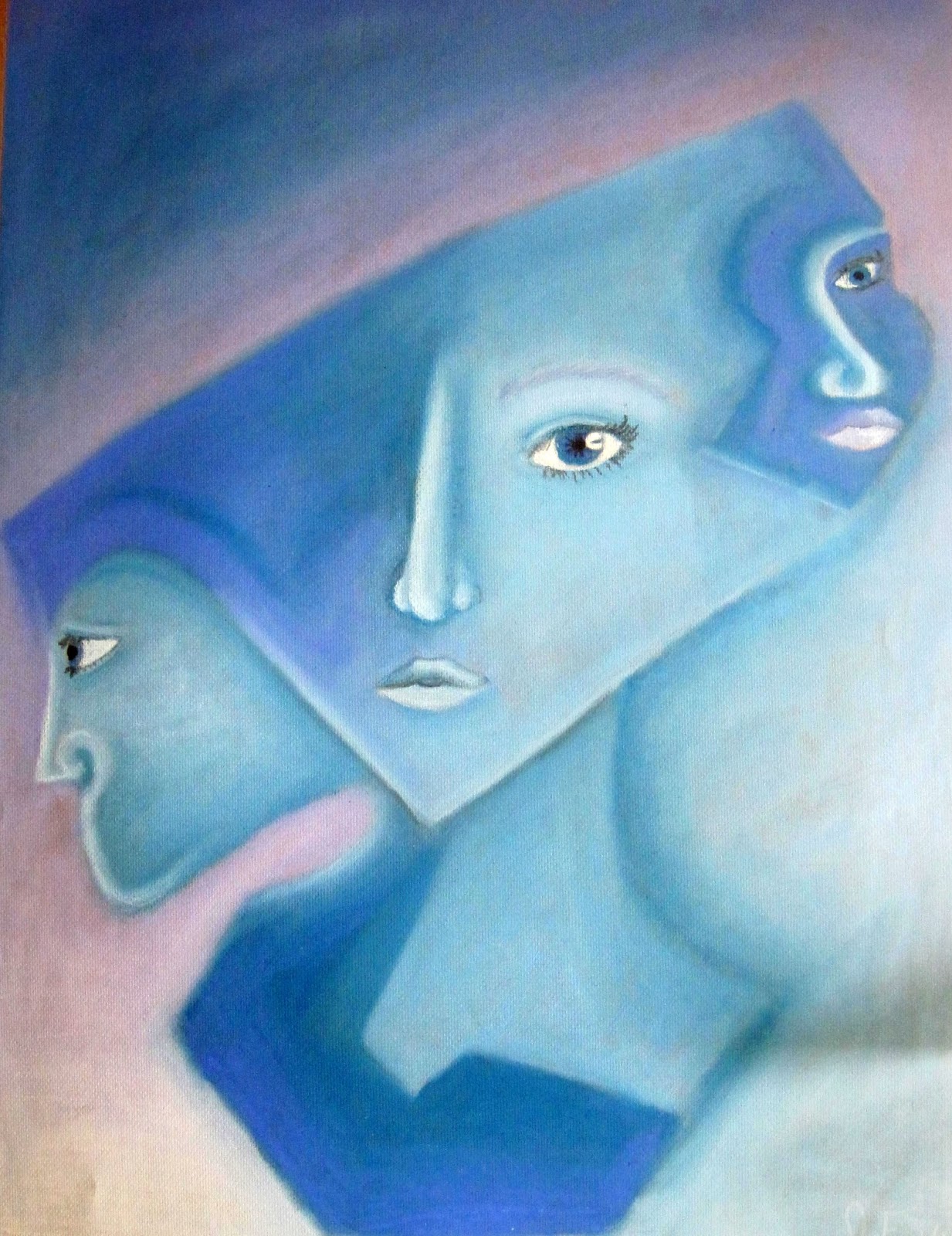
Now that we have studied the art work created by  Picasso in class and discussed the amazing evolution of his art, it is time to create a work of art based on the portraits he painted during and after the birth of cubism.  Your portrait should somehow combine 3 views of a face.  How do you do this?  Work it out in your sketchbook.  Overlap different views of a face you have already drawn or someone you want to draw.  Combine the faces by connecting them with lines, omitting some features, emphasizing others...experiment.
Picasso painted hundreds and hundreds of original creative portraits of people.  Some were realistic, expressionistic, cubist...etc.   Even though you are using Picasso as inspiration your portrait will be an original because you will put your twist on it.

Color:  Choose an analogous or monochromatic color scheme for the portrait  then decide if you want the background to stay within that color scheme or clash with it.  

Movement: Create movement within the piece by placing like colors in different areas of the artwork or by drawing lines that connect the faces or areas of the artwork. 

Emphasis:  Where is the focal Point? Is there an place that you want the viewer to go to in your piece?  How can you lead them there? Maybe with color or placement of shapes and lines. 

Balance:  When deciding your composition weight the areas evenly.  Notice below how negative and positive space are balanced. 


By Jane B, 2012


Clare H, 2012
Clare H, 2012


Brooke D, 2011

Josephine F, 2011


Picasso's sketches of James Sabartes.

Final painting, notice the references to the details in the sketch.

In this painting Picasso is starting to combine views of features.


Tuesday, February 17, 2015

Titus Kaphar

This weekend I read an article about Titus Kaphar an artist that resides in New Haven.  In the article he is described as an artist that is, "initiating a contemporary dialogue".   I would like you to discover how his artwork does just that.  Your goal is to look into the life and work of Titus Kaphar. Tell us something about his life and his art.  Choose a painting you find captivating and tell us about it.  I would like you to use the elements and principles of design in the description of his work.  In your sketchbook describe the painting you chose, including the size, media, and year it was painted.  Write why you chose this piece and if you know why it was painted by Kaphar.  We will begin the discussion on Wednesday April 27th.  Email me the image you chose so I can have it ready to view on Monday also print out a copy to keep in your sketchbook.


Kaphar ThisPlaceNeverFeltLikeHome Painterly Power Plays: Titus Kaphar

Monday, February 2, 2015

Gotta Love Music!


I could keep watching this over and over again!  


Wednesday, January 28, 2015

Express Your "SELF"

Advanced Drawing and Painting


Clara Lieu, “Self-Portrait No. 31″, from ”Falling

Sometimes an artist puts everything into
a series of works of art. The artwork carries the essence of the person with it. An artist that does just that is the inspiration for our first project (it will be a difficult one). We are going to jump right in draw a self-portrait that has expression. 


Clara Lieu an artist and Professor at Rhode Island School of Design created a series of expressionistic self-portraits that are executed so perfectly (if there is such a thing as a perfect work of art).  
Take a look. In your sketchbook write your reaction to her self-portraits. Which one do you like the best and why? I also want you to look up some creative self-portraits and put the links of them in the comment area of this post. 


The human face is universal, that is obvious, but drawing it a certain way is not. In this drawing lesson you will have many challenges, from  drawing your facial features in proportion to developing a creative idea and composition.  Ask yourself what you need to work on when it comes to drawing facial features.? Does the idea of drawing yourself make you excited or scared (or a little bit of both)?  No worries, relax and take the steps needed to make your drawing YOURS.  Planning, practicing, and being thoughtful about the process will help you be successful!


Steps to take:

·         *Draw your features separately and as a whole face.  Practice, Practice, Practice. This will count as a sketchbook grade.

·         *View styles of self-portraits, including the ones on this hand-out. See how other artists have approached this idea. Take to the web and search for images of self-portraits. Share your favorite with the class.

·         Design a composition that is interesting and that focuses on the mood you want to get across.  There has be an identifiable mood (at least by you and hopefully the viewer).  3 different approaches of your ideas should be sketched for a grade.

·         Do a gesture or contour drawing the actual size you plan on making your piece.  No smaller than 12 x 18 will be acceptable.

·         Work on drawing by building up values and focusing on each mark you make.  This is a long-term project and you should take your time, enjoy the process.


·         Complete a self-reflection in your sketchbook after  the class critique.  This important step allows your think about what you feel successful at what you need to work on. 


As an outcome of this lesson you will:
·         Generate and conceptualize a unique self-portrait that expresses a mood and/or expression that is personally meaningful.  (NCAS  Anchor Standard 1 and 2/Investigate, Plan, Make)
·         Demonstrate skills and techniques in drawing  (NCAS Anchor Standard 3/Reflect, Refine, Continue)
·         Critique self and peer work  (NCAS Anchor Standard 7/Perceive)
·         Identify the characteristics of self-portraits by Frida Kahlo and Clara Lieu

Project Requirements:
·         Sharing research and ideas with peers. Partaking in group discussions exploring various concepts with classmates.  Sketchbook:  Example of one self-portrait done by an artist that you find intriguing, to share with class.
·         Three thumbnail sketches of alternate concepts for drawing.
·         Completed drawing (see separate rubrics)
·         Completed self-reflection
·         Participating in final project critique.
Vocabulary:  value, contrast, proportion, cropping, space, depth, texture, emphasis, craftsmanship, persistence


Summing it up…

As an outcome of this lesson you will:
·         Generate and conceptualize a unique self-portrait that expresses a mood and/or expression that is personally meaningful.  (NCAS  Anchor Standard 1 and 2/Investigate, Plan, Make)
·         Demonstrate skills and techniques in drawing  (NCAS Anchor Standard 3/Reflect, Refine, Continue)
·         Critique self and peer work  (NCAS Anchor Standard 7/Perceive)
·         Identify the characteristics of self-portraits by Frida Kahlo and Clara Lieu

Project Requirements:
·         Sharing research and ideas with peers. Partaking in group discussions exploring various concepts with classmates.  Sketchbook:  Example of one self-portrait done by an artist that you find intriguing, to share with class.
·         Three thumbnail sketches of alternate concepts for drawing.
·         Completed drawing (see separate rubrics)
·         Completed self-reflection
·         Participating in final project critique.